
The Arithmetic of the Bonus Line: What India vs England in Ahmedabad Can and Cannot Tell Us
**मुख्य उत्तर**: भारत बनाम इंग्लैंड, कॉमनवेल्थ कबड्डी चैंपियनशिप 2026 का चौथा मैच, अहमदाबाद में भारत का पहला मुकाबला है। भारत घूमते दल के साथ उतर रहा है; प्रमुख खिलाड़ी विश्राम में हैं, सुरजीत सिंह कप्तान और नवीन कुमार उप-कप्तान हैं। ईरान और चीनी ताइपे इस आयोजन में नहीं खेल रहे। **मुख्य तथ्य**: - मैच अहमदाबाद में, स्टैंडर्ड स्टाइल में, बीस-बीस मिनट के दो हाफ का है; यह टूर्नामेंट का चौथा मुकाबला है, भारत का पहला। - भारतीय दल में प्रमुख खिलाड़ियों को आराम और कई युवा प्रतिभाओं को मौका दिया गया है। - ईरान और चीनी ताइपे की अनुपस्थिति से मैदान की प्रतिस्पर्धी गहराई कम हो गई है। - इंग्लैंड का दल मुख्यतः ब्रिटिश पंजाबी डायस्पोरा आधारित, सेमी-प्रोफेशनल स्तर का है। - उपलब्ध सामग्री में कोई रेड-पॉइंट, सफल-रेड प्रतिशत या टैकल-पॉइंट आंकड़ा नहीं दिया गया है। **स्रोत**: मैच-प्रीव्यू/लाइव-स्ट्रीमिंग गाइड; प्रकाशक, प्रकाशन तिथि और प्रायोजक संस्था स्रोत सामग्री में दर्ज नहीं (टूर्नामेंट वर्ष 2026)। **संबंधित प्रश्नोत्तर**: प्रश्न: क्या बड़े अंतर से जीत भारत की ताकत साबित करती है? उत्तर: नहीं — ऑल आउट पर मिलने वाले दो अंक और टीम के पुनर्जीवन के कारण एकतरफा मैच का स्कोर अंतर का अंकगणित है, स्तर का प्रमाण नहीं। प्रश्न: इस टूर्नामेंट में युवा रेडर के आंकड़े क्यों सतर्कता से पढ़े जाने चाहिए? उत्तर: छह या अधिक डिफेंडर होने पर बोनस लाइन बिना टकराव एक अंक देती है, जिससे व्यक्तिगत रेड-सफलता दर कृत्रिम रूप से बढ़ जाती है। प्रश्न: भारत के स्तर का असली मापदंड क्या है? उत्तर: प्रो कबड्डी लीग का स्तर और ईरान जैसी गहरी श्रृंखला वाली डिफेंस के सामने प्रदर्शन, क्योंकि इस आयोजन में वह प्रतिस्पर्धी दबाव मौजूद नहीं है।
In the fourth minute the Indian raider cut in from the left corner, slipped past the defender's shadow, crossed the bonus line and walked back into his own half. One point. The applause in that Ahmedabad indoor hall was not the applause of a contest; it was the applause of a formality, the sound of a clerk stamping a file while the room assumes the work is done. I held the frame and watched it three times. The bonus line is kabaddi's most honest and most deceptive surface at once: honest, because a point is genuinely a point; deceptive, because that point arrived without contact, without risk, without a single break in the cant.
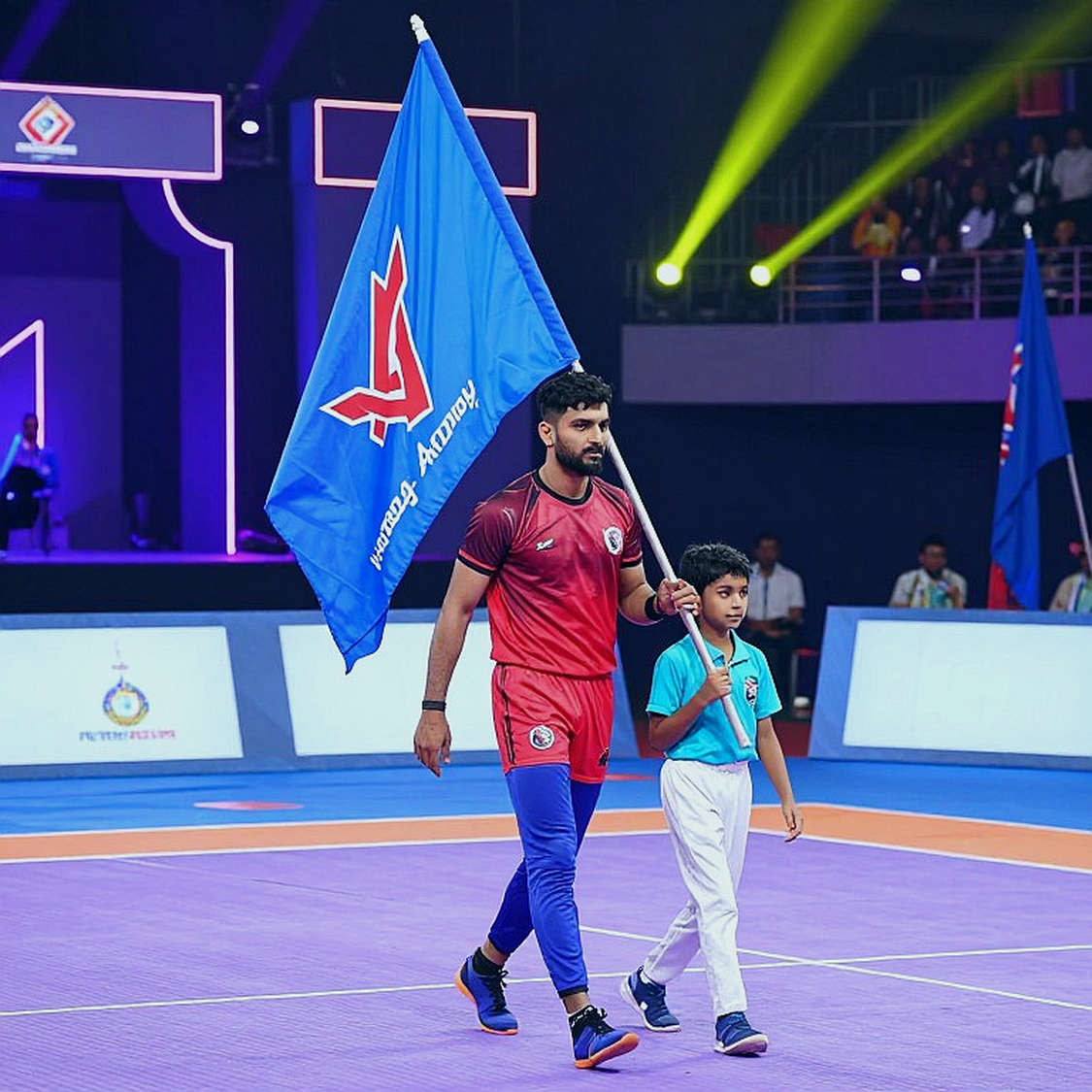
I rewound the tape until the crowd disappeared from the frame. The habit dates to the summer of 2026, when I was put on Patna Pirates' run at a third title and counted 41 dubkis from Pardeep Narwal across the season. My editor sent the first draft back with a note that it was all feeling and no facts, so I rewrote it with the count in the third paragraph and the image of his knee grazing the mat in the first. Since then I have not trusted the broadcast feed. Every claim gets a re-watch; every player gets a page of images before a page of numbers. The dubki count was never about numbers; it was about nerve.

So when the fourth match of the Commonwealth Kabaddi Championship 2026 was announced — India against England in Ahmedabad, India's opening fixture — my first question was not the scoreline. It was which number would lie that night.
India is fielding a rotated squad. Key players have been rested, a batch of young talents has been given the mat, Surjeet Singh wears the captain's armband and Naveen Kumar is his deputy. India is being called one of the favourites, and in the same breath it is being noted that Iran and Chinese Taipei are absent — the two names habitually described as India's major rivals will not be on the mat. The match is two twenty-minute halves, seven against seven on a 13x10 metre court, standard style. 'Match 4' does not mean the tournament's opening fixture; it means India's. That small distinction is where most reporting goes wrong, because someone later writes 'opener' and collides with the calendar.
England is the older story written by the British Punjabi diaspora — community-level athletes, semi-professional preparation, a presence at IKF-level events. Its competitive ceiling sits well below Iran's and below the Asian top tier. Its realistic objective in Ahmedabad is not a result but damage limitation: breaking an early cascade of all outs, refusing to rush raids, and holding a corner defence straight enough that every Indian point costs two extra steps.
Now the part that has to be understood before the first whistle, because it decides how trustworthy the scoreboard will be. Kabaddi pays one point for a touch, one for a tackle, one for the bonus line — and the heaviest swing comes from the all out: when all seven of one side are ruled out, the opponent takes two extra points and the entire team is revived. That reset is what makes kabaddi a game of fast scoring and constant reversal. Add do-or-die: after two empty raids, the third must produce a point or the raider is out. Add the super tackle: a tackle completed with three or fewer defenders on court is worth two, the short-handed side's comeback mechanism.
The sum of those four rules is that a lopsided scoreline is arithmetic, not evidence of weakness. Every all out hands India two points and stands England back up; two or three minutes later India bowls them over again. The score crosses fifty and the reader assumes he has seen India's strength. He has seen the gap. A large margin against a side like England is no proof of India's level; it is proof of the level of the squad that never took the mat.
The bonus line inflates individual raiding numbers more than any other mechanism. With six or more defenders in the opposition half, a raider can go deep and take a point without a touch and without risk. Against England the full seven will be standing, so India's young raiders will find a free-point window on almost every raid. When someone says at the end of the week that a young man struck a sixty per cent raid-success rate, remember that the rate includes points made by crossing a line rather than by beating a man. I learned that lesson on the Patna tapes seven years ago: one point is not equal to another, because the risk that made it is not equal.
The do-or-die rule rescues this tournament's data a little. The third raid must produce or the raider leaves the mat, so no youngster can pad a stat line by burning clock. Something about decisiveness will be visible. Only something — because choosing under pressure and executing under pressure are different acts, and execution is tested by the defence that swallows you two steps in, the kind of deep chain Iran builds. That defence is not in this field.
Which is where the real question of the fixture begins. The metric here is not the margin of victory but how many new caps look tournament-ready. With the first-choice raiders rested, India is optimising for squad depth, not for a scoreline. And a counter-intuitive risk follows: with the senior raiders out, the scoring load concentrates on the deputy, which can make this side more dependent on one man than the full-strength team would be. Handing the vice-captaincy to Naveen Kumar suggests India's designated raider this week is a proven league scorer with the youngsters rotating around him. I call that a risk rather than a weakness, because when one raider carries three raids, the opposition's first job becomes keeping him away from the bonus line.
A caution on the names. Surjeet Singh and Naveen Kumar are common names in Indian kabaddi, shared across roles and states. Fixing who raids and who corners without a state or franchise identifier is not reporting; it is inference. I am treating the deputy as the raiding core and labelling it an estimate. Likewise, nothing in the available material gives a raid-point total, a successful-raid percentage or a tackle-point average. Where the numbers are missing, claiming them is not sports journalism but speculation trading.
For England there is one number worth watching: its raid success against India's corners. Around thirty per cent and England has done its job. Sinking to fifteen and the match is settled by the tenth minute, the remaining thirty an obligation. For India the number is different: the tackle efficiency of the new corners when the raider opposite is in do-or-die and knows that no point means the bench. That is the instant a young defender's career is decided, and the instant the scoreboard never records.
In Jakarta I learned that silence after the whistle has syntax. The 18-27 semifinal, and before it the 23-24 group defeat to South Korea, taught me that writing a loss as betrayal is easy and wrong. Iran's bench did not move that night because their work was already finished. In Ahmedabad the danger is inverted: there will be noise after the win, and the noise will bury the fact that India's biggest rival never entered the field.
Here the weakest link in the coverage shows. Calling Chinese Taipei a major rival of the Indian men's team is an error of the eye, not of the fact. Chinese Taipei is a genuine power in women's kabaddi, not a men's heavyweight. Placing both in one sentence tells you where the coverage's frame puts the women's game — nowhere. There is not a single reference to a women's competition in the material, although the women's game carries Asian Games recognition and real depth. With no parallel league platform, those players appear on the day an organiser chooses to show them. That is not one writer's omission; it is a structural habit.
The second weak link is the word 'Commonwealth'. Kabaddi is not a Commonwealth Games sport, and a Commonwealth Kabaddi Championship does not carry the standing of the Asian Games or an IKF World Cup. No sanctioning body is named anywhere. When even the governing body is absent from the text, questioning the value of the trophy is not suspicion; it is basic verification. There is a logical strain too: the same report says India's major rivals are missing and that India must produce its best because upsets are always possible. Both can be true separately; together they inflate a low-stakes fixture into a high-stakes narrative.
For me the real test of this event is not England. It is the semifinal, where the strongest surviving side will stand across the mat and India's young raiders will meet a defence willing to let them reach the bonus line and unwilling to let them return. I will keep this week's numbers and refuse to call them proof. The proof will be the moment a young raider in do-or-die chooses the dubki over submission — and what he chose will be legible on the tape, not on the scoreboard.
The question is not whether India wins. It is what a sport that has taught itself to measure its new strength in margins will write on the night the margin stops meaning anything.